Chapter 26: Prompting as Programming
Why Text Is Now an API
Language models don’t execute code in the traditional sense—they generate text. But text is now a programming interface. A carefully constructed prompt can make a model translate languages, debug code, analyze data, write essays, or answer complex questions. The prompt is both the program and the user interface: natural language that specifies computation.
This is a paradigm shift. Traditional programming requires precise syntax, explicit control flow, and formal specifications. Prompt engineering uses natural language to describe desired behavior, relying on the model’s learned patterns to execute the task. The model interprets intent from text, maps it to internal representations learned during training, and generates appropriate output.
This chapter explains how prompting works, why wording matters, and how to design prompts as engineered artifacts. Understanding prompting is essential for building modern AI systems—it’s the primary control mechanism for language models in production.
Prompts as Instructions: Steering Probability Distributions
A prompt is text that precedes generation. The model uses it as context to predict what comes next. From the model’s perspective, a prompt is just the beginning of a sequence—it continues the pattern established by the input.
Example:
Prompt: "Translate to French: Hello"
Model sees: "Translate to French: Hello"
Model predicts next token(s): " Bonjour"
The model learned during training that text matching the pattern “Translate to [language]: [text]” is often followed by a translation. When the prompt matches this pattern, the model assigns high probability to translations as continuations.
This is how prompts control behavior: by establishing patterns the model recognizes. The prompt shapes the probability distribution over next tokens. A prompt that matches training patterns (questions → answers, code → explanations, instructions → executions) steers generation toward those continuations.
The control mechanism is indirect. You don’t specify the exact output—you specify context that makes desired outputs probable. The model’s training data contained countless examples of tasks framed as text patterns. Prompts exploit these patterns: construct input that looks like the beginning of a task, and the model completes it.
This differs fundamentally from traditional programming:
- Programming: Explicit algorithm, deterministic execution, precise syntax
- Prompting: Implicit specification, probabilistic generation, flexible natural language
Prompting is probabilistic control through learned associations. The better your prompt matches patterns in the training data, the more reliably the model performs the desired task.
Context Windows: The Model’s Working Memory
Every language model has a context window: the maximum number of tokens it can process as input. This is the model’s working memory—everything that fits in the context window is available for the next prediction. Anything outside is invisible.
Context windows vary by model:
- GPT-3: 4K tokens (~3,000 words)
- GPT-4: 8K-32K tokens (various tiers)
- GPT-4 Turbo: 128K tokens (~100,000 words)
- Claude 2: 100K tokens
- Claude 3: 200K tokens
These limits are architectural. The Transformer’s self-attention mechanism (Chapter 20) computes attention over all positions, requiring memory for sequence length . Longer contexts cost more memory and compute. Extensions (sparse attention, flash attention) push limits, but context windows remain finite.
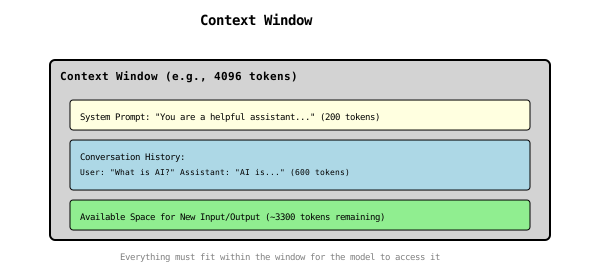
The context window forces trade-offs:
- System prompts: Instructions persistent across conversation (e.g., “You are an expert programmer”). These consume tokens but shape all responses.
- Conversation history: Past messages provide context but accumulate tokens. Long conversations eventually fill the window.
- Retrieved content: RAG (Chapter 27) injects external documents. More documents mean better grounding but consume more tokens.
- Available space: What remains for the user’s query and the model’s response.
Managing context is critical. Exceeding the window truncates earlier content—the model “forgets” old messages. Production systems implement strategies:
- Summarization: Compress old conversation history into summaries
- Selective retention: Keep important messages (system prompt, recent turns), drop less relevant middle turns
- Chunking: Break long documents into retrievable pieces that fit the window
Context window size affects capability. Longer windows enable:
- Analyzing entire codebases
- Processing long documents (reports, contracts, research papers)
- Maintaining extended conversations without forgetting
- Providing more examples in few-shot prompts
But longer windows cost more (compute, memory, latency, API pricing). Engineering prompts means balancing what to include vs. what to omit within token limits.
Prompt Patterns: Zero-Shot, Few-Shot, Chain-of-Thought
Effective prompting follows patterns that exploit the model’s training. These patterns shape how the model interprets the task.
Zero-Shot Prompting
Provide only the task description, no examples. Relies on the model’s pretraining to recognize the task.
Translate to French: The weather is nice today.
→ “Le temps est beau aujourd’hui.”
Zero-shot works for tasks the model saw frequently during training (translation, summarization, basic Q&A). It’s token-efficient but less reliable for complex or ambiguous tasks.
Few-Shot Prompting
Provide examples before the task. The model learns the pattern from demonstrations.
Translate to French:
Hello → Bonjour
Goodbye → Au revoir
Thank you → Merci
The weather is nice today. →
→ “Le temps est beau aujourd’hui.”
Few-shot prompting is in-context learning (Chapter 25): the model learns from examples in the prompt without parameter updates. More examples generally improve performance but consume tokens. Typical few-shot prompts use 1-5 examples.
The quality of examples matters. Clear, consistent examples teach the pattern effectively. Ambiguous or inconsistent examples confuse the model, degrading performance.
Chain-of-Thought (CoT) Prompting
For reasoning tasks, include intermediate steps in the prompt.
Problem: Roger has 5 tennis balls. He buys 2 more cans of tennis balls. Each can has 3 tennis balls. How many tennis balls does he have now?

Let's think step by step:
1. Roger starts with 5 tennis balls
2. He buys 2 cans
3. Each can has 3 balls, so 2 cans have 2 × 3 = 6 balls
4. Total: 5 + 6 = 11 balls

Answer: 11
Chain-of-thought unlocks multi-step reasoning by making intermediate steps explicit. The model generates reasoning before the answer, using each generated token as context for the next. This prevents the model from “guessing” the answer directly—it must show its work.
CoT improves performance on:
- Math word problems
- Logic puzzles
- Multi-hop question answering
- Complex decision-making
The prompt can explicitly instruct chain-of-thought: “Let’s think step by step” or “Explain your reasoning before answering.”
Role Prompting
Frame the model as an expert or persona to shape behavior.
You are an experienced Python developer. Debug the following code:

def factorial(n):
    if n = 1:
        return 1
    return n * factorial(n-1)
→ The model responds as a Python expert, identifying the syntax error (= should be ==) and suggesting a fix.
Role prompting works because training data contains text where experts explain concepts, doctors diagnose conditions, teachers answer questions. The model learns associations between roles and appropriate responses.
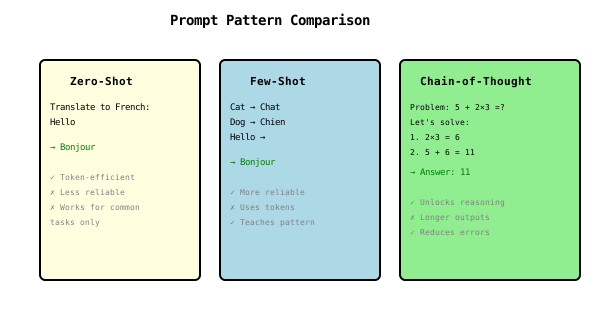
The diagram compares prompting strategies: zero-shot (minimal), few-shot (examples), and chain-of-thought (explicit reasoning). Each has trade-offs in tokens, reliability, and capability.
Prompt Fragility: Why Wording Matters
Language models are sensitive to phrasing. Small changes to prompts can produce dramatically different outputs. This prompt fragility is a consequence of how models learn: statistical patterns in training data.
Example:
Prompt 1: "Summarize this article."
Output: Concise 2-sentence summary

Prompt 2: "Write a summary of this article."
Output: Verbose 5-paragraph summary
The model interprets “summarize” and “write a summary” differently based on training data distributions. “Summarize” appears more often in contexts requiring brevity. “Write a summary” appears in contexts allowing detail. The model learned these associations and generates accordingly.
Another example:
Prompt 1: "Is the following review positive or negative? 'The movie was okay.'"
Output: "Negative"

Prompt 2: "Classify this review as positive or negative: 'The movie was okay.'"
Output: "Neutral/Mixed"
Framing affects interpretation. “Is X or Y?” suggests a binary choice. “Classify as X or Y” allows other options. The model’s behavior changes based on subtle linguistic cues.
Why fragility happens:
-
Training data patterns: The model learned that certain phrasings correlate with certain continuations. Prompt wording determines which patterns activate.
-
Ambiguity: Natural language is inherently ambiguous. The same request can be phrased countless ways, each with slightly different implications.
-
Probability shaping: Prompts shift probability distributions. Small changes alter which tokens are likely, cascading through generation.
-
No explicit task understanding: The model doesn’t “understand” the task—it pattern-matches and predicts. Different prompts activate different patterns.
Implications for engineering:
- Test prompts extensively. A prompt that works on one example may fail on others.
- Iterate on wording. Try variations, measure performance, refine.
- Document effective prompts. Treat them as code—versioned, tested, maintained.
- Use prompt templates. Standardized formats reduce fragility by constraining variation.
Prompt engineering is empirical. There’s no formula for the perfect prompt—only experimentation, testing, and refinement. Successful production systems invest significant effort in prompt optimization.
Prompt Engineering as Software Engineering
Prompts are now engineered artifacts. They specify computation, control behavior, and determine system outcomes. Treating prompts as casual afterthoughts leads to unreliable systems.
Prompts are code. They should be:
- Versioned: Track changes, roll back failures
- Tested: Automated evaluation on test sets
- Documented: Explain intent, edge cases, failure modes
- Modular: Composable templates, reusable components
- Reviewed: Code review for prompts, especially in production
Prompt templates enable reusability:
TRANSLATION_PROMPT = """
Translate the following {source_lang} text to {target_lang}:

{text}

Translation:"""

# Usage:
prompt = TRANSLATION_PROMPT.format(
    source_lang="English",
    target_lang="Spanish",
    text="Hello, how are you?"
)
Templates separate structure (the prompt pattern) from content (variable inputs). This enables testing across many inputs with consistent framing.
Evaluation is critical. Manually inspecting a few outputs doesn’t validate a prompt. Production systems require:
- Automated tests: Run prompts against test sets, check outputs match expectations
- Metrics: Accuracy, relevance, consistency, safety
- A/B testing: Compare prompt variations on real traffic
- Human evaluation: Sample outputs for quality assessment
Failure modes require monitoring:
- Prompt injection: User inputs that override instructions
- Context overflow: Prompts + inputs exceed context window
- Degradation with distribution shift: Prompts optimized on one dataset fail on new data
- Safety failures: Prompts that accidentally elicit harmful outputs
Production prompts include guardrails:
- Explicit instructions for edge cases
- Safety guidelines (“Do not provide medical advice”)
- Output format constraints (“Return only JSON”)
- Fallback behaviors (“If unsure, say ‘I don’t know’“)
Engineering Takeaway
Prompting has become the primary interface for controlling language models. Understanding how prompts work—and how to engineer them effectively—is now essential for building AI systems.
Prompts are the new code—treat them as versioned, tested artifacts
Prompts determine system behavior as much as traditional code. A poorly designed prompt causes failures just like a bug in code. Production systems maintain prompt libraries: versioned, tested, documented collections of prompts for different tasks. Changes go through review, testing, and staged rollout—just like code deployments.
Context window is working memory—design prompts to fit essential information
Token limits force prioritization. Include what’s necessary (system instructions, relevant examples, user query), omit what’s not. For conversations, summarize or drop old turns. For RAG, retrieve only the most relevant documents. Monitor token usage in production—hitting limits degrades performance.
Few-shot learning reduces need for fine-tuning but costs tokens
Providing examples in prompts teaches tasks without training. This is cheaper and faster than fine-tuning but uses tokens every inference. The trade-off: few-shot is flexible (change behavior by changing examples) but expensive at scale. Fine-tuning is rigid (requires retraining for changes) but efficient at inference. Choose based on task frequency and update cadence.
Chain-of-thought unlocks reasoning on complex tasks
For tasks requiring multiple steps (math, logic, analysis), instruct the model to show reasoning. “Let’s think step by step” or “Explain your reasoning” significantly improve accuracy on complex problems. CoT is now standard for reasoning-heavy applications (customer support, technical analysis, decision-making).
Prompt templates enable reusability across use cases
Hardcoding prompts is brittle. Templates with placeholders enable consistent behavior across inputs. Build template libraries for common patterns (translation, summarization, Q&A, code generation). Test templates thoroughly before deploying to production.
Testing prompts is essential—subtle changes break behavior
Prompt fragility means testing is not optional. Build test suites: inputs → expected outputs. Run tests when prompts change. Track performance metrics over time. A prompt that works initially may degrade as model versions change or data distributions shift. Continuous testing catches regressions.
Why prompt engineering is now a core skill for AI applications
Every AI application built on language models requires prompt engineering. It’s not a temporary workaround—it’s the fundamental control mechanism. Engineers building AI systems must understand prompt patterns, context management, and evaluation. Prompt engineering is software engineering applied to natural language interfaces. Organizations hiring for AI roles now list “prompt engineering” as a required skill alongside traditional software development.
The lesson: Prompts are how we program language models. They’re text, but they function as code—specifying computation, controlling behavior, determining outcomes. Effective prompting requires understanding how models interpret text, testing rigorously, and treating prompts as engineered artifacts. Production AI systems succeed or fail based on prompt quality. Mastering prompting is now essential for building reliable, capable AI applications.
References and Further Reading
Chain-of-Thought Prompting Elicits Reasoning in Large Language Models – Jason Wei, Xuezhi Wang, Dale Schuurmans, et al. (2022) https://arxiv.org/abs/2201.11903
Wei et al. demonstrated that prompting models to generate intermediate reasoning steps dramatically improves performance on complex tasks. Chain-of-thought prompting works by making the model’s reasoning explicit, allowing each step to inform subsequent predictions. The paper showed this simple technique (adding “Let’s think step by step”) unlocks reasoning abilities in large models that were absent in smaller models, making it an emergent capability tied to scale. This work established CoT as a standard technique for reasoning-heavy applications. Understanding chain-of-thought is essential for building AI systems that handle complex problem-solving, multi-step analysis, and decision-making tasks.
Pre-train, Prompt, and Predict: A Systematic Survey of Prompting Methods in Natural Language Processing – Pengfei Liu, Weizhe Yuan, Jinlan Fu, et al. (2023) https://arxiv.org/abs/2107.13586
Liu et al. provide a comprehensive survey of prompting techniques, taxonomies, and best practices. The paper systematically categorizes prompt engineering approaches: few-shot vs. zero-shot, discrete vs. continuous prompts, manually designed vs. automatically generated. It explains why prompting works (exploiting patterns learned during pretraining), when it fails (distribution mismatch, ambiguity), and how to improve it (prompt tuning, calibration). This survey is the definitive reference for understanding the landscape of prompting methods. Reading it clarifies the principles underlying effective prompts and provides a framework for designing robust prompting strategies in production systems.
The Prompt Report: A Systematic Survey of Prompting Techniques – Sander Schulhoff, Michael Ilie, Nishant Balepur, et al. (2024) https://arxiv.org/abs/2406.06608
This recent comprehensive survey catalogs prompting techniques used in practice, including role prompting, instruction following, meta-prompting, and prompt optimization methods. Schulhoff et al. synthesize research and industry practices, providing actionable guidance for practitioners. The report covers prompt fragility, evaluation strategies, and production considerations (safety, monitoring, versioning). It bridges academic research and industry deployment, making it essential reading for engineers building real AI systems. Understanding the techniques documented here enables building more reliable, robust prompt-based applications.