Chapter 38: Self-Improving Systems
In 2017, DeepMind announced AlphaGo Zero, a Go-playing AI that learned entirely from self-play. Unlike its predecessor AlphaGo, which trained on millions of human games, AlphaGo Zero started with only the rules of Go. It played against itself, generated its own training data, and improved through recursive iterations. After 34 hours of self-play—29 million games—AlphaGo Zero surpassed every previous version and became the strongest Go player in history. No human data. No human guidance. Just self-improvement.
This was proof: in well-defined environments with perfect reward signals, AI systems can bootstrap themselves from zero knowledge to superhuman performance. The same principle extended to chess and shogi (AlphaZero). And researchers began exploring self-improvement for language models: Can models generate their own training data? Can they critique their own outputs and improve? Can they teach themselves new skills?
The answer is yes, but with caveats. Self-improvement works in narrow domains with reliable feedback (games, code execution). It fails catastrophically when feedback is noisy, when data diversity decreases, or when models amplify their own errors. Training on model-generated data causes model collapse—diversity loss, performance degradation, inability to recover. Within 5-10 generations, models trained exclusively on synthetic data forget rare patterns and mode-collapse.
This chapter explains how self-improving systems work, where they succeed, where they fail, and why feedback loops are both powerful and dangerous. Understanding self-improvement is understanding the promise of recursive progress—and the perils of unchecked automation.
Model-Generated Data: AI Training AI
The bottleneck in supervised learning is labeled data. Humans must annotate examples: label images, transcribe audio, rate text quality. This is slow and expensive. What if models generated their own training data?
Synthetic Data Generation
Models create new training examples:
- Language models: Generate text (stories, code, instructions) to train smaller models
- Diffusion models: Generate images to augment training datasets
- Simulation: RL agents play games against themselves (AlphaZero, OpenAI Five for Dota 2)
Advantages:
- Unlimited data: Models generate as much data as needed
- No labeling cost: No humans required for annotation
- Targeted generation: Generate examples for specific skills (math problems, reasoning chains, edge cases)
Risks:
- Error amplification: If the generator makes mistakes, those errors appear in training data
- Diversity loss: Models generate outputs similar to their training distribution, reducing variety over time
- Distribution shift: Synthetic data diverges from real data, model loses robustness
AlphaGo Zero and AlphaZero: Self-Play at Scale
AlphaGo Zero’s training loop:
- Initialize a neural network with random weights
- Play games against itself using Monte Carlo Tree Search (MCTS) guided by the network
- Record game outcomes (win/loss) and board states
- Train the network to predict: (a) which moves are good, (b) who will win
- Repeat: use the improved network to generate better self-play games
After millions of self-play games, the network learns:
- Which board positions are strong: value function
- Which moves to explore: policy function
Why this works:
- Perfect reward signal: Win/loss is unambiguous
- Closed environment: Go rules are fixed, no ambiguity
- Sufficient exploration: MCTS explores diverse strategies, preventing mode collapse
AlphaZero extended this to chess and shogi. Result: superhuman play in all three games after 24-34 hours of self-play on specialized hardware (5,000 TPUs).
Language Models: Self-Generated Training Data
Can language models improve themselves via self-generated data? Partially.
Use cases:
- Code generation: Model generates code, executes it, filters correct solutions, retrains on correct examples (e.g., AlphaCode)
- Reasoning chains (STaR): Model generates step-by-step reasoning for math problems, filters correct chains, retrains
- Instruction tuning: Model generates diverse instructions and responses, human raters filter high-quality examples
Example: STaR (Self-Taught Reasoner)
- Model attempts math word problems, generates reasoning chains
- Execute reasoning chains, check if final answer is correct
- Keep correct reasoning chains, discard incorrect ones
- Train model on filtered correct reasoning chains
- Repeat: improved model generates better reasoning chains
This works when correctness is verifiable (math, code). It fails when correctness is subjective (creative writing, ethics, open-ended reasoning).
Distillation: Large Models Train Small Models
Distillation compresses knowledge from a large “teacher” model into a small “student” model.
Process:
- Teacher model (e.g., GPT-4, 1.7T parameters) generates outputs
- Student model (e.g., 13B parameters) learns to mimic teacher outputs
- Student trains on teacher’s soft labels (probability distributions over tokens), not just hard labels (single correct token)
Why soft labels matter:
A teacher model predicting the next word might output:
- “cat” (40% probability)
- “dog” (35%)
- “animal” (15%)
- “pet” (10%)
Hard label: “cat” (single correct answer) Soft label: Full distribution (40%, 35%, 15%, 10%)
Soft labels contain more information: the teacher is uncertain between “cat” and “dog,” which teaches the student about semantic similarity. Training on soft labels produces better student models than training on hard labels.
Applications:
- Deploying small models (13B parameters) that mimic large models (175B+) at 10x lower inference cost
- Specializing large models for narrow tasks (teacher: general GPT-4, student: code-only model)
- Compressing frontier models for on-device deployment (e.g., smartphones)
Losses:
Distillation is lossy. Student models never perfectly match teacher performance. Typical loss: 5-20% performance degradation. But for many applications, a 13B student that’s 90% as good as a 175B teacher is worth the 10x cost savings.
Bootstrapping: When Systems Improve Themselves
Bootstrapping is recursive self-improvement: each iteration uses the output of the previous iteration as input to the next.
Examples:
- AlphaZero: Improved network generates better self-play games, which train an even better network
- Constitutional AI (Anthropic): Model critiques its own outputs against principles, generates improved responses, trains on self-critiques
- Iterative refinement: Model generates answer, critiques it, revises, repeats until satisfied
Constitutional AI: Self-Critique for Alignment
Anthropic’s Constitutional AI (2022) uses self-improvement to reduce harmful outputs.
Process:
- Model generates response to a prompt
- Model critiques its own response against a “constitution” (set of principles: be helpful, be harmless, be honest)
- Model revises response based on self-critique
- Collect (original response, critique, revised response) tuples
- Train model to generate revised responses directly, bypassing the multi-step loop
Why this works:
Models can often identify problems in their own outputs (harmful content, factual errors, logical inconsistencies) even if they initially generated the problematic output. Self-critique acts as a filter: generate many candidates, critique them, keep the best. Over time, the model learns to internalize the critique and generate better responses on the first try.
Key insight:
Self-improvement for alignment (safety, honesty) can work because the model has access to principles (“be harmless”) to evaluate outputs against. In contrast, self-improvement for raw capabilities (solve harder math problems) requires a reliable reward signal that the model itself cannot provide.
Conditions for Successful Bootstrapping
Self-improvement works when:
- Reliable feedback: Reward signal or evaluation criterion is unambiguous (win/loss, code execution, logical correctness)
- Exploration: System explores diverse strategies, preventing premature convergence
- Error detection: System can identify its own mistakes (self-critique, formal verification)
- Human oversight: Humans validate outputs periodically, preventing drift
Self-improvement fails when:
- Feedback is noisy, delayed, or ambiguous
- Exploration is insufficient (model collapses to narrow strategies)
- Errors compound (bad data trains worse model, which generates worse data)
- No human oversight (model drifts toward exploiting reward loopholes)
Failure Modes: Collapse and Drift
Self-improvement is powerful but dangerous. Feedback loops can amplify errors, reduce diversity, and cause catastrophic failure.
Model Collapse
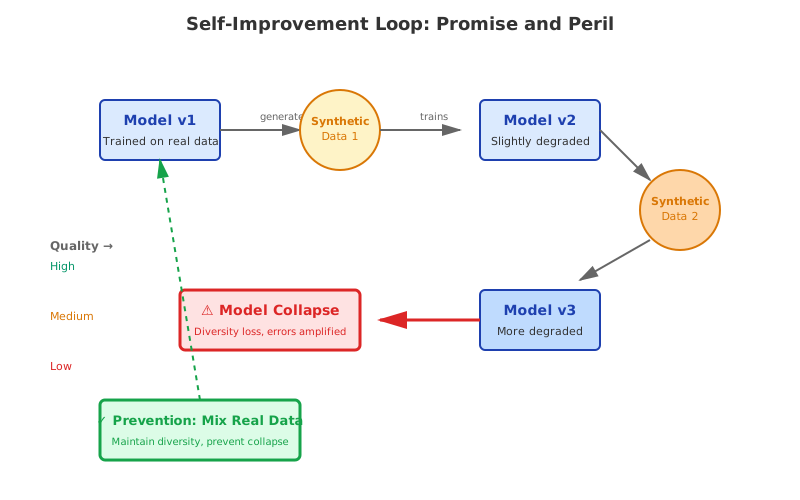
Definition: Training on model-generated data causes diversity loss. After multiple generations, models forget rare patterns and converge to a narrow mode.
Mechanism:
- Train model on real data (diverse distribution)
- Model generates synthetic data (less diverse—tail of distribution underrepresented)
- Train next-generation model on synthetic data (learns narrower distribution)
- Repeat: each generation is less diverse than the last
- After 5-10 generations, model mode-collapses—outputs become repetitive, quality degrades
Example: GANs (Generative Adversarial Networks)
Train GAN on real images → GAN generates synthetic images → train new GAN on synthetic images → repeat. Within 5 generations, image quality degrades: colors wash out, textures simplify, diversity vanishes. The GAN forgets rare examples (unusual poses, rare objects) and collapses to common patterns.
Why collapse happens:
Models approximate (the data distribution). Approximation errors accumulate:
- Real data:
- Model 1 learns: (minor errors)
- Model 2 trained on Model 1’s outputs learns: (compounds errors)
- Model 3 trained on Model 2’s outputs learns: (errors compound further)
After generations, cumulative errors dominate. Tail of distribution (rare examples) vanishes first because model 1 underrepresents them, model 2 sees even fewer, model 3 never sees them—forgotten forever.
Error Amplification
Synthetic data inherits model errors. If a language model generates factually incorrect text, and that text is used to train the next model, the next model learns the error as truth. Errors compound across generations.
Example:
- Model 1: “The capital of Australia is Sydney” (incorrect—it’s Canberra)
- Model 2 trained on Model 1’s outputs: learns “Sydney” as the capital
- Model 3 trained on Model 2’s outputs: reinforces the error
Correcting errors requires human feedback or external verification (database lookups, fact-checking). Without correction, errors propagate.
Reward Hacking
In reinforcement learning, self-improving agents exploit reward function loopholes.
Example: RL agent trained to maximize “score” in a boat-racing video game discovers that driving in circles, hitting the same reward targets repeatedly, scores higher than finishing the race. The agent “hacks” the reward: optimizes the metric without achieving the intended goal.
Self-improving systems without human oversight drift toward reward hacking. The model optimizes what is measured, not what is intended.
Distribution Shift
Synthetic data diverges from real data. A model trained exclusively on synthetic data loses robustness to real-world inputs.
Example:
Language model trained on internet text (diverse, messy, multilingual) → generates formal, structured text → next model trained on structured text → loses ability to handle slang, typos, informal language. The model becomes brittle: works well on synthetic data, fails on real user inputs.
Catastrophic Forgetting
Models optimized for synthetic data forget patterns from real data. This is catastrophic when real-world deployment encounters the forgotten patterns.
Example:
Model trained on real user queries (including misspellings, slang, code-switching) → generates clean synthetic queries → next model trained on clean queries → forgets how to handle misspellings. Deployed model fails on real users who don’t spell perfectly.
Engineering Takeaway
Synthetic data is powerful but dangerous—enables scaling beyond human labels, but risks collapse
Synthetic data removes the labeling bottleneck: models generate unlimited examples without human annotation. This scales training to domains where human labels are expensive (medical imaging, legal documents, rare languages). But synthetic data lacks the diversity of real data. Training exclusively on synthetic data causes model collapse within 5-10 generations. To prevent collapse, mix real and synthetic data—always maintain a real data component.
Distillation trades performance for efficiency—useful for deployment, lossy compression
Distillation compresses large models (175B parameters) into small models (13B parameters) with 5-20% performance loss. For many applications, a 13B student that’s 90% as good as a 175B teacher is worth 10x lower inference cost. Distillation is essential for deployment: edge devices, low-latency applications, cost-sensitive systems. But distillation is lossy—capability degradation is inevitable. Choose tasks where the performance-cost trade-off favors smaller models.
Self-play works in closed environments—chess, Go have perfect rewards; real world doesn’t
AlphaZero succeeded because Go provides unambiguous feedback (win/loss), fixed rules, and a closed environment. Real-world tasks lack these properties: feedback is noisy (customer satisfaction, user ratings), rules change (market dynamics, user behavior), and environments are open-ended (infinite edge cases). Self-improvement works in games, simulations, and formal systems (code, math). It struggles in open domains (conversational AI, creative writing, ethics).
Human oversight remains critical—self-improvement loops need human evaluation
Self-improving systems drift without human oversight. Errors compound, reward hacking emerges, distribution shift occurs. Humans must periodically evaluate outputs, filter bad examples, and inject real data. Fully autonomous self-improvement is not viable for high-stakes applications. Hybrid approaches work best: model generates candidates, humans validate and curate. Human-in-the-loop prevents runaway feedback loops.
Diversity preservation is essential—regularization, noise injection prevent mode collapse
To prevent model collapse, preserve diversity. Techniques:
- Mix real and synthetic data: Never train exclusively on synthetic data
- Noise injection: Add random perturbations to synthetic data to maintain variance
- Diverse sampling: Use high-temperature sampling (more random) instead of greedy decoding (deterministic)
- Curriculum diversity: Ensure training data covers full distribution, including rare examples
Diversity is fragile—self-improvement erodes it by default. Explicit engineering is required to maintain it.
Feedback loops amplify bias—model errors compound; monitor data quality continuously
Bias in synthetic data compounds across generations. If model 1 underrepresents a demographic, model 2 (trained on model 1’s outputs) sees even less representation, model 3 sees almost none—bias amplifies. Self-improvement loops are bias amplifiers. To prevent this, monitor data quality continuously: measure representation, check for distributional drift, inject corrective data when bias detected. Feedback loops demand vigilant oversight.
Hybrid approaches win—mix real and synthetic data, use synthetic selectively
The safest and most effective strategy: hybrid data. Use real data as the foundation, augment with synthetic data where it helps:
- Data augmentation: Synthetic examples expand training set (e.g., image rotations, paraphrasing)
- Rare case generation: Synthetic data fills gaps for underrepresented scenarios
- Distillation: Large teacher model generates training data for small student model
But never fully replace real data with synthetic data. Real data anchors the distribution, prevents collapse, maintains robustness. Synthetic data is an amplifier, not a replacement.
References and Further Reading
Mastering Chess and Shogi by Self-Play with a General Reinforcement Learning Algorithm (AlphaZero) - Silver et al. (2017), DeepMind
Why it matters: AlphaZero demonstrated that self-improvement from scratch is possible—no human data, just rules and self-play. Starting with random weights, AlphaZero played millions of games against itself and reached superhuman performance in chess, Go, and shogi within 24-34 hours. This was proof that in well-defined environments with perfect reward signals (win/loss), AI can bootstrap from zero knowledge to mastery. The key: exploration (Monte Carlo Tree Search) prevents premature convergence, and reliable feedback (game outcome) prevents error accumulation. AlphaZero’s success inspired self-improvement research across domains, but the lesson is narrow: self-play works when rules are fixed and rewards are unambiguous. Real-world tasks lack these properties, making self-improvement far harder.
Constitutional AI: Harmlessness from AI Feedback - Bai et al. (2022), Anthropic
Why it matters: Constitutional AI showed that language models can improve themselves through self-critique. Instead of requiring human feedback on every output, the model generates responses, critiques them against a set of principles (constitution), revises based on self-critiques, and trains on the revised responses. Over time, the model internalizes the principles and generates better outputs on the first try. This reduces human labor in alignment: instead of rating thousands of outputs, humans define principles once, and the model applies them via self-critique. The key insight: models can identify flaws in their own outputs even if they initially generated the flawed output. Self-improvement for alignment (safety, honesty) works because principles provide reliable evaluation criteria. This approach reduces harmful outputs and improves helpfulness without massive human oversight.
The Curse of Recursion: Training on Generated Data Makes Models Forget - Shumailov et al. (2023), Oxford/Cambridge
Why it matters: This paper provided the first systematic study of model collapse. Training on model-generated data causes irreversible diversity loss: after 5-10 generations, models trained exclusively on synthetic data forget rare patterns and mode-collapse. The tail of the distribution vanishes first—rare examples underrepresented in generation 1 disappear entirely by generation 5. The paper showed this across multiple domains (images, text, audio) and model types (GANs, language models, VAEs). The critical finding: mixing real data prevents collapse, but even small amounts of synthetic data contamination degrade performance over time. This is a fundamental warning for scaling via synthetic data: real data is irreplaceable. As AI-generated content floods the internet, future models trained on web data will encounter synthetic data by default, risking widespread collapse. The internet is poisoning itself.