Chapter 39: Artificial General Intelligence
The term “Artificial General Intelligence” carries weight. It evokes visions of machines that think, reason, and learn like humans—or surpass them. News articles ask: “Is GPT-4 AGI?” Tech leaders claim AGI is “5-10 years away.” Conferences debate when AGI will arrive and what it will mean for humanity. The discourse is filled with hype, speculation, and mysticism.
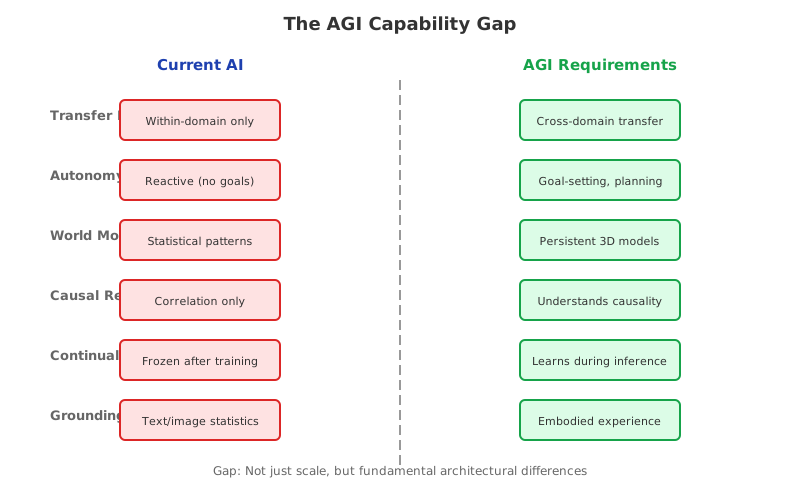
This chapter cuts through the noise. AGI has a technical meaning: a system that matches human-level performance across all cognitive tasks, with the ability to transfer knowledge broadly and operate autonomously. By this definition, current AI systems—including GPT-4, AlphaGo, multimodal models—are not AGI. They excel at narrow tasks but fail at general transfer. They predict text or classify images but lack agency, world models, and robust grounding.
The gap between current AI and AGI is not a matter of scale. It is architectural, conceptual, and epistemological. Large language models optimize next-token prediction—a statistical task. AGI requires goal-setting, planning, causal reasoning, and continual learning—capabilities current models do not have. The path from LLMs to AGI is not obvious. It may require fundamental breakthroughs, not just bigger models.
This chapter demystifies AGI: what it means, what it requires, why current systems fall short, and what would change if AGI existed. The conclusion is grounded: narrow AI will dominate for years, possibly decades. Engineers should focus on building reliable, useful systems today, not waiting for AGI to solve problems.
What AGI Actually Means: Transfer and Autonomy
Defining AGI precisely is difficult because “intelligence” is multifaceted. But most definitions converge on two requirements: broad transfer and autonomy.
Broad Transfer: Learning One Task, Applying to Many
Humans learn skills and apply them across domains:
- Learn to cook → apply similar principles to chemistry (mixing, heating, timing)
- Learn to play chess → apply strategic thinking to business decisions
- Learn a programming language → quickly learn another language by analogy
This is transfer learning at its most general: knowledge from domain A improves performance in unrelated domain B. Current AI systems transfer within narrow domains but fail across fundamentally different tasks.
Current AI transfer:
- GPT-3 trained on text → fine-tuned for code generation (related domain: text-like sequences)
- Vision model trained on ImageNet → fine-tuned for medical imaging (related domain: images)
- RL agent trained on Atari games → fails on board games without retraining
Human-level transfer:
- Cooking skills → repair bicycle (cross-domain abstraction: understand systems, troubleshoot, improvise)
- Reading music → learn new instrument by analogy (transfer musical notation, rhythm, melody concepts)
- Playing soccer → learn basketball quickly (transfer spatial awareness, teamwork, strategy)
AGI requires this level of transfer: learn from one domain, generalize to unrelated domains with minimal new data. Current models do not have this capability. They generalize within the distribution they trained on, but out-of-distribution generalization is brittle.
Autonomy: Setting Goals and Planning
Humans set their own goals, plan multi-step actions, and adapt when plans fail:
- Goal: “Get a promotion” → Plan: improve skills, take on projects, network → Adapt when blocked
- Goal: “Cook dinner” → Plan: check ingredients, follow recipe, adjust if missing items
- Goal: “Learn to play guitar” → Plan: practice scales, learn songs, seek feedback → Adjust based on progress
This is autonomy: the ability to formulate goals, break them into subgoals, execute plans, and adjust based on feedback. Current AI systems are reactive—they respond to prompts but do not set goals.
Current AI:
- GPT-4: Responds to user prompts, generates text, stops when done. No intrinsic goals.
- AlphaGo: Wins Go games (goal provided by training objective), does nothing else
- Self-driving cars: Follow routes (goal provided by navigation system), do not decide where to go
AGI:
- Decides “I want to learn physics” → finds resources, studies, asks questions, evaluates understanding
- Notices a problem (e.g., inefficiency in a system) → proposes solution, implements, validates
- Sets long-term goals (years) and adjusts plans as circumstances change
Autonomy is not just planning—it is goal formation. Current models optimize loss functions defined by humans. AGI would define its own objectives.
What Current Models Lack: World Models, Goals, Grounding
Large language models achieve impressive capabilities: they write essays, solve math problems, generate code. But they lack fundamental properties required for AGI.
No Persistent World Models
Humans maintain internal representations of the physical world: objects persist, obey physics, have 3D structure, interact causally. Models do not.
Test: Object permanence
Show a model a video: ball rolls behind a box, out of view. Ask: “Where is the ball?” Humans know the ball still exists behind the box. Models struggle—they do not track object states across frames.
Test: Physics reasoning
Show an image: stack of blocks, one block partially off the edge. Ask: “What happens if I remove the bottom block?” Humans predict collapse. Models guess randomly—they lack physics understanding.
Current multimodal models (GPT-4V, Gemini) learn statistical associations between visual patterns and language but do not build 3D world models. They describe what they see but do not understand causality, dynamics, or object interactions.
No Intrinsic Goals
Models optimize objectives defined during training: minimize cross-entropy loss, maximize reward in RL environments. But they do not set their own goals.
GPT-4 generates text to minimize loss on next-token prediction. It has no intrinsic drive to learn, explore, or achieve outcomes. When the prompt ends, the model stops. There is no curiosity, no planning beyond the current sequence, no long-term objectives.
Humans have intrinsic motivation: curiosity (explore the unknown), mastery (improve skills), autonomy (control one’s actions). These drives shape behavior even without external rewards. AGI would require similar intrinsic goals—but how to specify them? Loss functions are proxies for human intent, not true goals.
Weak Grounding
Language models learn from text—words and symbols. But text is disconnected from the physical world. The model reads “gravity pulls objects down” but never experiences gravity. It predicts “fire is hot” but never feels heat.
Grounding means connecting symbols to sensory experience. Multimodal models (Chapter 37) improve grounding by linking text and images, but this is statistical, not experiential. The model sees millions of images of dogs and associates “dog” with visual patterns, but it does not know what it is like to pet a dog, hear it bark, or interact with it.
Humans ground language in embodied experience: we learn “heavy” by lifting objects, “hot” by feeling temperature, “fast” by moving. Models lack bodies, sensors, and motor control. Their grounding is second-hand: learned from data, not from interaction.
No Causal Reasoning
Models learn correlations: which words co-occur, which images have similar patterns. But correlation is not causation. Models predict (probability of Y given X) but do not understand whether X causes Y, Y causes X, or both are caused by a hidden factor Z.
Example: Spurious correlations
A model trained on medical data might learn: “patients who receive treatment X have higher mortality.” Does treatment X cause death? Or do doctors prescribe X to already critically ill patients? The model cannot distinguish. It learns the correlation (X correlates with death) but not the causal structure.
Causal reasoning requires interventions: manipulate X, observe whether Y changes. Models trained on static datasets cannot perform interventions—they only observe. Without causal models, AGI cannot plan effectively: planning requires predicting outcomes of actions, which requires understanding causality.
No Continual Learning
Models are trained once, then deployed with frozen weights. They do not learn during inference. A model deployed in January 2024 has the same weights in December 2024—it does not improve from user interactions.
Humans learn continuously: every conversation, every observation updates our world model. We adapt to new environments, learn from mistakes, refine skills over time. AGI would require continual learning: update knowledge as the world changes, integrate feedback in real-time, improve from experience.
Current models lack this capability. They suffer from catastrophic forgetting: training on new data erases previously learned patterns. Continual learning without forgetting remains an unsolved problem.
Why LLMs Are Not AGI: Prediction ≠ Agency
Language models generate impressive outputs: essays, code, poems, conversations. But impressive outputs do not imply understanding or agency.
LLMs Are Prediction Engines
GPT-4 optimizes . Given a prompt, it predicts the most likely next word, then the next, token by token, until a stopping criterion is met. This is a statistical task: find patterns in training data, generalize to new prompts.
Prediction is powerful—it enables coherent text generation. But prediction is not reasoning, planning, or understanding. The model does not “think” about the prompt, does not “understand” what it is writing. It samples from a learned distribution over sequences.
No Planning, No Backtracking
Humans plan before acting. Writing an essay: outline main points, organize arguments, revise drafts. Solving a math problem: try an approach, notice it’s wrong, backtrack, try another approach.
LLMs generate text left-to-right, token by token, with no backtracking. If the model starts down a wrong path, it cannot revise—it must continue until the sequence ends. Recent techniques (chain-of-thought, self-critique) mimic planning by generating reasoning chains, but this is still sequential generation, not true planning.
True planning requires:
- Evaluate multiple candidate plans before committing
- Predict long-term consequences of actions
- Revise plans when intermediate steps fail
LLMs approximate this via multi-step generation (generate, critique, revise), but this is expensive (multiple forward passes) and still lacks the flexibility of human planning.
Brittleness and Out-of-Distribution Failure
LLMs generalize within their training distribution but fail on out-of-distribution inputs. They perform well on common prompts but degrade on edge cases, adversarial inputs, or novel domains.
Example: Legal reasoning
GPT-4 performs well on typical legal questions (common topics, standard phrasing). But on edge cases—novel legal theories, cross-jurisdictional nuances, highly specialized domains—performance degrades. The model memorizes common patterns but does not deeply understand legal principles.
Humans generalize more robustly. We transfer knowledge from seen cases to unseen cases by reasoning from principles. Models memorize examples and interpolate. This works within the training distribution but fails outside it.
Hallucinations: Confidence Without Knowledge
LLMs generate fluent, confident-sounding text even when factually incorrect. The model does not know what it does not know. High probability output ≠ truth.
Example: Citation hallucination
Ask GPT-4 for academic references on a niche topic. The model generates plausible-sounding titles, authors, journals—but the papers do not exist. The model optimizes for fluency and coherence, not factual accuracy. It “hallucinates” citations that fit the pattern of real references.
AGI would require epistemic awareness: knowing the limits of one’s knowledge, expressing uncertainty, seeking information when uncertain. LLMs lack this awareness. They generate text with equal confidence regardless of whether the underlying knowledge is strong or weak.
What Would Change If AGI Existed
AGI, if achieved, would be transformative. But speculation about AGI often veers into science fiction. Here, we focus on concrete technical capabilities AGI would enable.
Autonomous Research
An AGI scientist could:
- Formulate hypotheses based on prior research
- Design experiments to test hypotheses
- Execute experiments (if embodied or connected to lab equipment)
- Interpret results, update hypotheses, iterate
This would accelerate research: AGI works 24/7, does not need sleep, can parallelize across many instances. But current models cannot do this—they lack curiosity (intrinsic drive to explore), domain grounding (deep understanding of scientific principles), and experimental autonomy (ability to design and conduct experiments independently).
Recursive Self-Improvement
AGI could improve its own architecture and training algorithms. If AGI understands machine learning deeply enough, it could:
- Propose new architectures more efficient than Transformers
- Design better training algorithms (optimizers, loss functions)
- Generate better training data
This would lead to recursive self-improvement: each iteration creates a smarter system, which creates an even smarter system, accelerating indefinitely. This is the “intelligence explosion” scenario. However, current models cannot design better models—they lack the meta-cognitive ability to reason about their own limitations and propose improvements.
General-Purpose Robotics
An AGI robot could:
- Cook meals (plan recipe, manipulate ingredients, adjust to missing items)
- Clean and organize (understand clutter, categorize objects, navigate spaces)
- Repair equipment (diagnose problems, identify solutions, execute fixes)
This requires: perception (see and understand 3D environment), manipulation (fine motor control), planning (multi-step task decomposition), and adaptation (handle unexpected obstacles). Current robots excel at narrow tasks (pick-and-place in factories) but fail at general-purpose tasks in unstructured environments.
Economic Disruption
If AGI automates most cognitive labor, economic structures change radically:
- Knowledge work (law, medicine, engineering, writing) largely automated
- Labor demand shifts: from cognitive tasks to roles requiring human interaction, creativity, or embodied presence
- Productivity surges, but distribution of gains is a policy question (who benefits from automation?)
This scenario assumes AGI reaches human-level capability across all domains. Even then, deployment is constrained by regulation, trust, and infrastructure. Economic disruption would be gradual, not instant.
Safety Challenges
Misaligned AGI—a system with autonomy and intelligence but goals misaligned with human values—poses existential risk. If AGI optimizes an objective misspecified by humans, outcomes could be catastrophic. This is the “alignment problem” at AGI-scale: ensuring powerful autonomous systems act in humanity’s interest.
But current systems are not AGI. They lack autonomy, do not set their own goals, and optimize human-defined loss functions. Safety research on current models (Chapter 35) is necessary and valuable, but AGI-specific risks are speculative until AGI architectures exist.
Engineering Takeaway
AGI is not imminent—current models lack fundamental capabilities
Despite impressive performance on benchmarks, current AI systems do not have the core properties required for AGI: broad transfer, autonomy, persistent world models, causal reasoning, continual learning. The gap is not merely quantitative (more data, more parameters)—it is qualitative (different architectures, different learning paradigms). Claiming “AGI is 5 years away” is speculation, not engineering forecasting. Architectural breakthroughs may be required, and we cannot predict when they will occur.
Narrow AI dominates for years—task-specific systems outperform general systems economically
Even if AGI were achievable soon, narrow AI systems would dominate economically. A specialized fraud detection model outperforms a general-purpose AGI for fraud detection: it is cheaper, faster, more reliable, and easier to deploy. General-purpose systems sacrifice efficiency for flexibility. For most applications, flexibility is not worth the cost. Narrow AI—task-specific models optimized for performance and cost—will dominate the market for years, possibly decades.
Transfer learning ≠ general intelligence—models transfer within domains, not across fundamentally different tasks
BERT fine-tunes from text classification to question answering (within NLP). ViT fine-tunes from ImageNet to medical imaging (within vision). But GPT-4 cannot transfer from language to robotic manipulation, and AlphaGo cannot transfer from Go to stock trading. Transfer works within related domains but fails across fundamentally different modalities or tasks. General intelligence requires transfer across any domain, which current models cannot do.
Agency requires new architectures—LLMs are reactive, AGI needs goal-setting and planning
LLMs respond to prompts but do not set goals. To achieve autonomy, models must formulate objectives, plan multi-step actions, and adapt when plans fail. This requires architectures beyond next-token prediction: models must evaluate candidate plans, predict long-term outcomes, and revise strategies based on feedback. These capabilities may require integrating symbolic reasoning, reinforcement learning, and world models—research areas separate from LLM development. Scaling LLMs alone is unlikely to produce agency.
Safety research necessary now—even non-AGI systems cause harm; prepare before AGI arrives
AI safety is not just about AGI. Current models already cause harm: bias, misinformation, misuse. Safety research today—alignment, robustness, interpretability—builds foundations for future systems. If AGI arrives, we need safety frameworks in place. Waiting until AGI exists to address safety is too late. Proactive research now reduces risk later. But safety research should focus on current systems, not speculate about AGI scenarios that may not materialize.
Hype obscures progress—calling GPT-4 “AGI” confuses prediction with understanding
Labeling GPT-4 or similar models as “AGI” is misleading. It conflates impressive narrow capabilities (text generation, question answering) with general intelligence (broad transfer, autonomy, causal reasoning). This hype obscures the real progress: LLMs are remarkable prediction engines, enabling new applications. But they are not AGI. Confusing the two distorts research priorities, misallocates resources, and sets unrealistic public expectations. Clarity matters: call LLMs what they are—powerful, narrow tools.
Engineering focus—build reliable, narrow systems; don’t wait for AGI to solve problems
Engineers should focus on solving real problems with current technology, not waiting for AGI. Narrow AI—fraud detection, medical imaging, language translation, recommendation systems—delivers value today. These systems are deployable, cost-effective, and reliable. Waiting for AGI to “solve everything” wastes opportunity. Build useful systems now, iterate, improve incrementally. AGI may arrive eventually, but engineering progress happens through incremental improvements, not waiting for breakthroughs.
References and Further Reading
On the Measure of Intelligence - Chollet (2019), Google
Why it matters: François Chollet argues that intelligence is not task-specific performance (beating humans at chess, Go, or image classification) but skill-acquisition efficiency—the ability to learn new tasks quickly with minimal examples. He introduces the ARC (Abstraction and Reasoning Corpus) benchmark, which tests generalization to novel tasks with minimal data. Current models, including GPT-4, struggle with ARC despite superhuman performance on standard benchmarks. This paper reframes AGI: it is not about memorizing vast datasets but about flexible, sample-efficient learning. Chollet shows that current models excel at interpolation (within training distribution) but fail at extrapolation (novel tasks requiring abstraction). True general intelligence requires the latter. This paper grounds the AGI debate in measurable properties, not vague claims.
Reward is Enough - Silver et al. (2021), DeepMind
Why it matters: David Silver and colleagues hypothesize that maximizing reward in sufficiently complex environments could lead to general intelligence. They argue that abilities like perception, knowledge, reasoning, planning, and social intelligence emerge from reward-seeking in rich environments. This is a controversial claim: it suggests AGI might arise from scaling reinforcement learning in increasingly realistic simulations, without explicit design of capabilities. Critics argue that real-world reward signals are sparse, ambiguous, and difficult to specify—unlike games where rewards are clear. The paper is speculative but influential: it frames AGI as an emergent property of optimization in complex environments. Whether reward is truly “enough” remains an open question, but the hypothesis is testable.
The Bitter Lesson - Sutton (2019), Essay
Why it matters: Richard Sutton argues that the history of AI shows a consistent pattern: general methods that leverage computation and learning outperform approaches based on human knowledge and domain-specific heuristics. Chess, Go, speech recognition, and computer vision were all solved by scaling general algorithms (search, learning), not by encoding expert knowledge. The “bitter lesson”: human insight and cleverness are less valuable than scale and learning. Sutton predicts AGI will come from scaling general methods, not hand-crafted architectures. Critics note that some breakthroughs (Transformers, residual networks) required architectural insights, not just scale. The debate: will AGI emerge from scaling existing methods (LLMs, RL), or does it require new architectures? Sutton’s essay influenced the “scaling hypothesis” that dominates current AI development.